React Native + Mindbody API: Build It the Secure Way
 October 14, 20267 min read
The first architecture diagram for a studio app usually has two boxes. Your React Native app on the left, Mindbody on the right, one arrow between them. You drop the Api-Key into a .env file, react-native-config picks it up, the class schedule renders, and the demo goes well.
Then you ship to the App Store, and that arrow becomes a problem you can't patch quickly.
This guide covers what most Mindbody API tutorials skip: why a mobile app should never talk to Mindbody directly, what the backend in the middle actually does, and the booking, identity and phone-specific rules that separate an app built against documentation from one built for a real studio. If you're scoping a branded studio app, this is the architecture to get right before your first release, because it's the hardest one to change afterward.
Your React Native .env File Is Already Public
Environment variables in React Native aren't read at runtime from a server you control. They're inlined into the JavaScript bundle at build time, so whatever sits in .env ships as a string literal inside the app you publish.
The official React Native security guide is blunt about this: never store sensitive API keys in app code. Tools like react-native-config are for endpoints and feature flags, not secrets.
Getting the key out takes minutes. Unzip the .apk and search the bundle, or point a phone at Charles or Proxyman and read the Api-Key header off any request. Hermes bytecode and obfuscation add friction, not protection.
This isn't theoretical. The Leaky Apps study presented at ACM CCS 2025 found 416 valid credentials across 65 services in 10,331 Android and iOS apps. It also found developers often removed secrets in later builds without revoking them.
The Mindbody API adds a worse failure mode. If the app issues its own staff token through POST /usertoken/issue, a staff username and password ship in the bundle too. That's staff-level access to member records on devices you don't control.
The rule is simple: anything in a client binary is published.
What a Backend for Frontend Does for a Mindbody Booking App
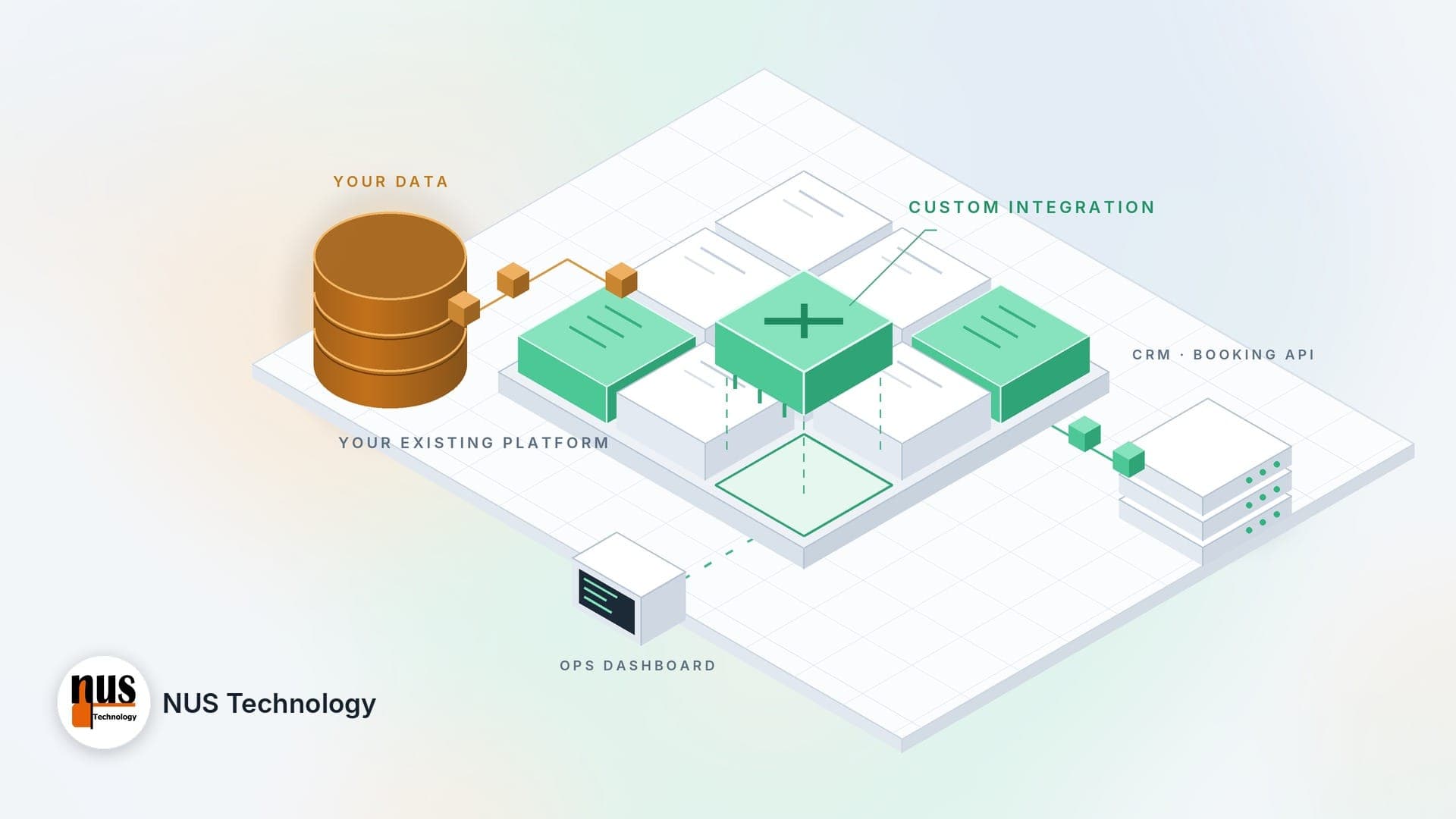
The fix is a third box: a backend for frontend (BFF). It's one service shaped around your screens, not around Mindbody's resources. Your app doesn't integrate with Mindbody. Your backend does, and the app integrates with your backend.

The third box isn't overhead. It's the only place secrets and version logic can live.
| Concern | Where it lives |
|---|---|
| Mindbody credentials | BFF only, loaded from a secret manager |
| Reads | Served from your own copy of the data |
| Writes | Queued, then sent with a retry policy you control |
| Member sessions | Issued by you, separate from Mindbody staff auth |
| Response shape | Yours, stable across Mindbody changes |
Two more reasons make it non-negotiable.
Calls are metered. Mindbody's developer portal lists pricing at $0.002 per call, free under 5,000 calls per billing cycle. Confirm rates in your own account, since older figures still circulate. If 2,000 members open the app at 6am and each phone asks Mindbody directly, that's 2,000 calls. A backend with a warm cache makes one.
You can't force an update. When a response shape changes, a backend fix deploys in minutes. Getting every member onto a new build takes weeks, and some never update.
The trade-off is one more service to run. A small Node.js or Ruby on Rails service on managed cloud infrastructure keeps that cost modest.
Keep Your Copy Fresh With Mindbody Webhooks, Not Polling
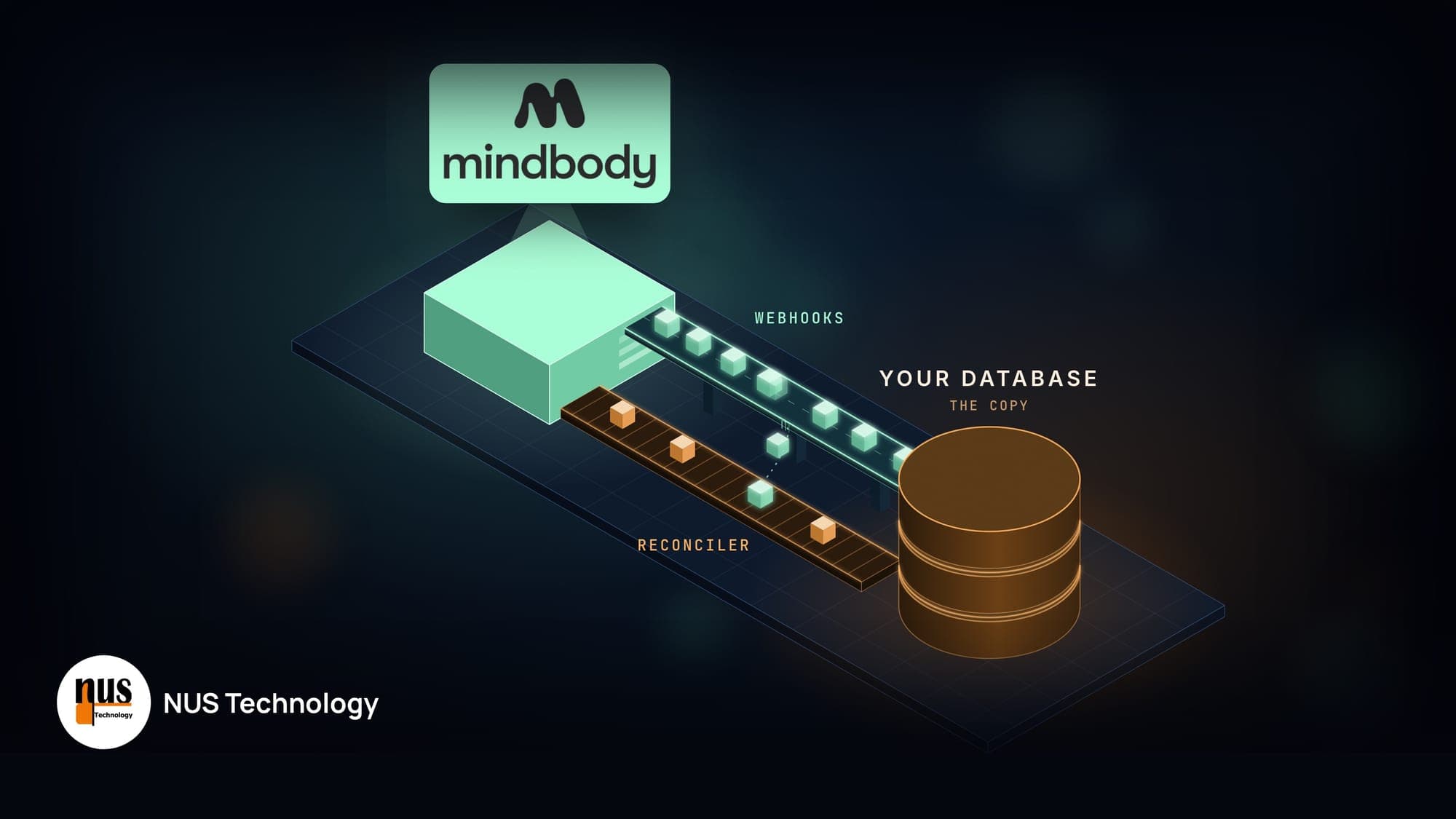
A cached copy is only as good as the way you refresh it. Polling every few minutes burns metered calls and is still late. Mindbody's Webhooks API pushes events to your backend instead, and in a recent product update Mindbody reported that 99.99% of webhook events, including bookings, cancellations and check-ins, are now delivered.
Webhooks also solve something no phone can: waitlist promotion. A spot opens because someone else cancelled, at an hour nobody has the app open. Your backend receives the event, updates its copy and sends a push notification, with quiet hours based on the studio's timezone rather than your server's.
Keep a nightly reconciliation job anyway. 99.99% isn't 100%, and a scheduled diff against the source is cheap insurance. When your local view is a few minutes old, say so: "as of 14:32" with pull-to-refresh beats a spinner pretending to be live.
This server-side layer is also where the studio's other tools connect. When NUS took over BXR's React Native app for a premium London boxing studio, the team built a Stripe payment layer alongside Mindbody to enable Apple Pay and Google Pay, and mapped bookings, cancellations and check-ins into Klaviyo events for retention campaigns. Reconciling transactions across two platforms is complex system integration, and it belongs on a server.
Resolve Booking Eligibility Before You Render the Button
This is where Mindbody stops behaving like a generic REST API.
There are three things to book, not one. Classes are group sessions on a schedule, appointments are one-to-one time with a staff member, and enrollments are multi-session courses booked as a unit. Each has its own availability rules and booking calls. Most first versions ship classes only, then collect tickets asking why personal training can't be booked.
Whether a member can book isn't a field you read. It depends on which pricing options they hold, whether those are within their valid dates, whether they cover this class type at this location, and how many sessions remain. Mindbody recently began exposing pricing activation timing through the API specifically to reduce eligibility errors.
An immature app shows Book to everyone and lets checkout reject the member after they thought they had a place. A mature one resolves eligibility on the server first, so the button is either live or replaced with "your current pack doesn't cover this class" and a link to one that does. That single decision separates an app built against the Mindbody API docs from one built for a real studio.

Every branch that ends in "no" needs its own sentence on screen.
Apply the same thinking to late-cancel rules: show "free to cancel until 6:00pm today" before the member commits, not as a penalty after.
Identity and Multi-Location: Where Studio Apps Break Quietly
Signing up is a lookup, not an insert. Most members already exist in Mindbody because the front desk created their record when they bought their first class. An app that treats registration as "create a client" produces a second record for the same person: visit history on one, remaining sessions on the other, and a staff member on the phone working out which is real. Start registration with a lookup and, on a match, switch to a verify-and-link flow.
SiteId is state, not configuration. Every request carries a SiteId, and it's tempting to hard-code it. That works until the studio opens a second location. Each site is a separate universe: IDs don't carry across, and one person can exist as two unrelated client records. Your app needs a location context that travels with every request, a way to switch it, and screens that say "your account at this location". Building that up front costs an afternoon. Retrofitting it later is a data migration.
React Native Booking Bugs That Only Show Up on Phones
The double tap. Signal drops in a stairwell, the button seems dead, the member taps again: two requests, two bookings. Generate a requestId on the device before the request leaves, and have the backend deduplicate on it.
Optimistic UI has a boundary. Favouriting a class can update instantly because you own that state. A booking can't, because you don't own the last spot.
Losing the race is normal. Two members, one place. The second deserves "that spot just went, join the waitlist?", not a red error dialog. It happens every week, so design the screen for it.
Timezones bite silently. Class times come back in the studio's local time, but React Native formats dates in the device's timezone. A travelling member, or a franchise spanning two states, sees the wrong hour. It never reproduces on a developer machine sitting in the studio's timezone, which is exactly why it reaches production.
Test these on real devices with throttled networks. A disciplined QA process catches the double tap before your members do.
FAQ
Can a React Native app call the Mindbody API directly?
Technically yes, but it shouldn't. Anything in your app bundle, including environment variables, can be extracted, and the React Native security guide says never to store sensitive API keys in app code. Put a backend between the app and Mindbody that holds the credentials, caches reads and queues writes. The app then authenticates only against your backend, using sessions you issue.
How much does the Mindbody API cost?
Mindbody's developer portal lists metered pricing of $0.002 per call, with free access for developers under 5,000 calls per billing cycle. Figures quoted elsewhere vary, and some reflect older pricing models, so confirm current rates in your own developer account before budgeting. Caching reads and using webhooks instead of polling are the most effective ways to keep call volume down.
Can members book classes offline in a Mindbody app?
No. You can't hold a spot you don't control, so a booking only exists once Mindbody confirms it. An app that queues bookings offline and shows them as successful will produce failed bookings and frustrated members. What works offline is the cached schedule with a clear "last updated" time, plus browsing and favouriting, until the connection returns and the member can book for real.
Can I use serverless functions instead of a full backend?
For the credential proxy, yes. React Native's documentation explicitly suggests options like AWS Lambda or Google Cloud Functions to forward requests with a secret. A production studio app, though, also needs a database for cached reads, a queue for retried writes, deduplication for double taps and an endpoint for webhooks. That usually adds up to a small dedicated service rather than a few isolated functions.
The Takeaway
A React Native app built on the Mindbody API is really three systems: the app, your backend and Mindbody. Keep secrets and version logic in the middle, keep your copy fresh with webhooks, and resolve eligibility, identity and location before a member ever taps Book. Get that architecture right before launch, because a backend changes in minutes and an installed app doesn't.
If you're planning a branded studio app, or inheriting one that already talks to Mindbody directly, we're happy to talk through your architecture. You can also browse our case studies or learn more about our mobile app development work.