Web, Mobile, AI, RAG

Folio — AI-Powered Research Workspace

Overview

Folio is an AI-powered research workspace that helps users organize information, explore research materials, and transform findings into reusable knowledge.

Built around a Retrieval-Augmented Generation (RAG) architecture, Folio processes documents and web content into searchable knowledge. Users can ask questions grounded in their research sources, inspect supporting citations, and develop findings through personal notes and notebooks.

The project demonstrates NUS Technology's capabilities in AI backend engineering, document processing, hybrid information retrieval, and knowledge management, supported by web and native mobile applications.

Overlapping squaresWhat We Built

A Connected Workspace for Research and Knowledge Management

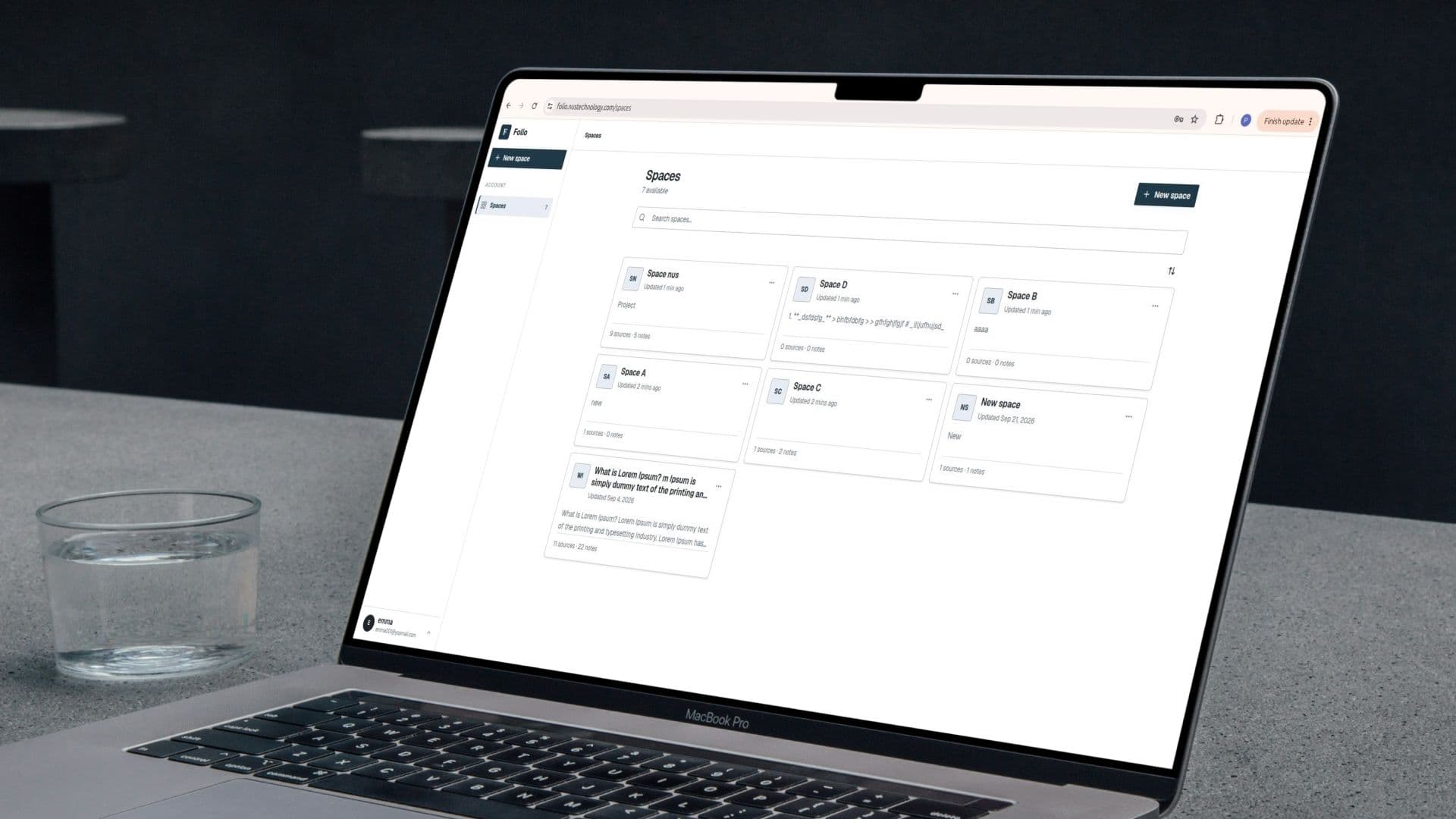
Folio allows users to organize research into independent Spaces, each containing its own source library, AI conversations, notes, and notebook. Users can upload documents, import web articles, or manually add text sources, which are processed and indexed for AI-powered retrieval.

The AI assistant supports questions across an entire Space or within a selected source, generating answers with citations linked to supporting passages. Users can inspect the original evidence, continue conversations with follow-up questions, and save useful answers as notes for future reference.

Folio also supports a continuous knowledge-building workflow. Users can convert selected notes into independently indexed research sources, making previously captured findings available for future retrieval. The experience is accessible through a responsive web application and native iOS and Android clients, all connected to a shared AI backend.

Folio_Visual_1.jpg
Overlapping squaresTech & Architecture

A RAG Backend Connecting Document Processing, Search, and AI Generation

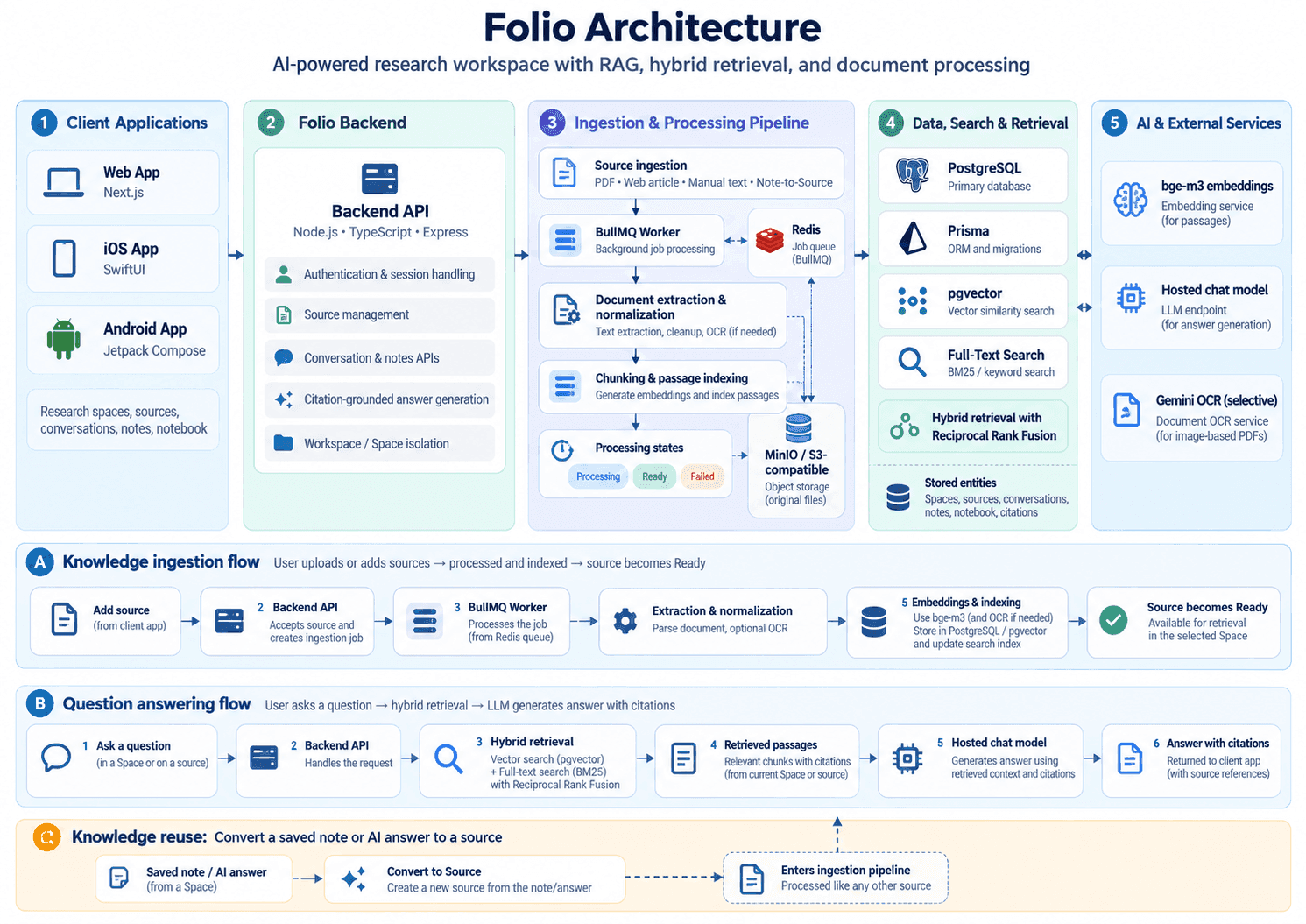
Folio uses a Node.js and TypeScript backend to coordinate source ingestion, knowledge indexing, retrieval, and AI response generation. A dedicated BullMQ worker handles asynchronous document processing, while Redis manages background jobs. PostgreSQL and Prisma provide the structured data layer, with MinIO supporting S3-compatible object storage.

The RAG pipeline combines pgvector semantic search and PostgreSQL full-text search using Reciprocal Rank Fusion. Document content is extracted, divided into retrievable passages, and indexed with source-location metadata. Retrieved passages are supplied to a hosted language model for answer generation, while the backend validates citation references and preserves supporting evidence. Embedding services and selective Gemini OCR support the knowledge-processing pipeline.

The Next.js web application and native iOS and Android clients communicate with the backend through shared APIs. This architecture centralizes document processing, information retrieval, and AI orchestration while allowing each client to implement platform-specific interfaces and research workflows.

Folio Architecture Workflow Diagram.png

Technology Stack

  • Backend: Node.js, TypeScript, Express

  • Database & Search: PostgreSQL, Prisma, pgvector, Full-Text Search

  • AI & RAG: OpenAI-compatible APIs, bge-m3 Embeddings, Reciprocal Rank Fusion

  • Document Processing: LangChain Text Splitters, PDF.js, Google Gemini OCR

  • Background Processing & Storage: BullMQ, Redis, MinIO

  • Real-Time Communication: Server-Sent Events (SSE)

  • Web: Next.js, React, TypeScript

  • Mobile: Swift, SwiftUI, Kotlin, Jetpack Compose

Overlapping squaresTechnical Highlights

Engineering a Traceable and Continuously Growing AI Knowledge Base

Green tick circle

Hybrid Retrieval with Source Isolation: Combines pgvector semantic search and PostgreSQL full-text search using Reciprocal Rank Fusion. Retrieval is restricted to processed sources within the active research Space or a selected document, preventing unrelated research contexts from being mixed.

Green tick circle

Asynchronous Document Ingestion: A dedicated BullMQ worker handles content extraction, normalization, chunking, embedding, and indexing. Redis supports background job execution, with persisted processing states and controlled retries for recoverable failures.

Green tick circle

Structure-Aware Semantic Chunking: Combines LangChain text splitting with custom logic that identifies passage boundaries through heading transitions and cosine-distance changes. Passages retain source-location metadata to support citation mapping and navigation.

Green tick circle

Evidence-Linked AI Generation: Validates AI-generated citation references against retrieved passages and preserves supporting evidence with saved answers. When retrieval returns no relevant evidence, the backend provides a predefined insufficiency response without invoking the chat model.

Green tick circle

Document Processing and Cost Optimization: Prioritizes local PDF extraction, with selective Gemini OCR for scanned documents or complex table pages. Identical files from the same user can reuse existing extractions, reducing redundant processing and external AI calls.

Green tick circle

Knowledge Reuse with Persistent Citations: Converts selected notes and saved AI answers into independently indexed research sources while preserving their origin. Citation snapshots remain available after the underlying passages are re-indexed, maintaining references to previously captured evidence.

Explore More Demos

RoomScan — LiDAR Room Scanning & Spatial Collaboration
Mobile

RoomScan — LiDAR Room Scanning & Spatial Collaboration

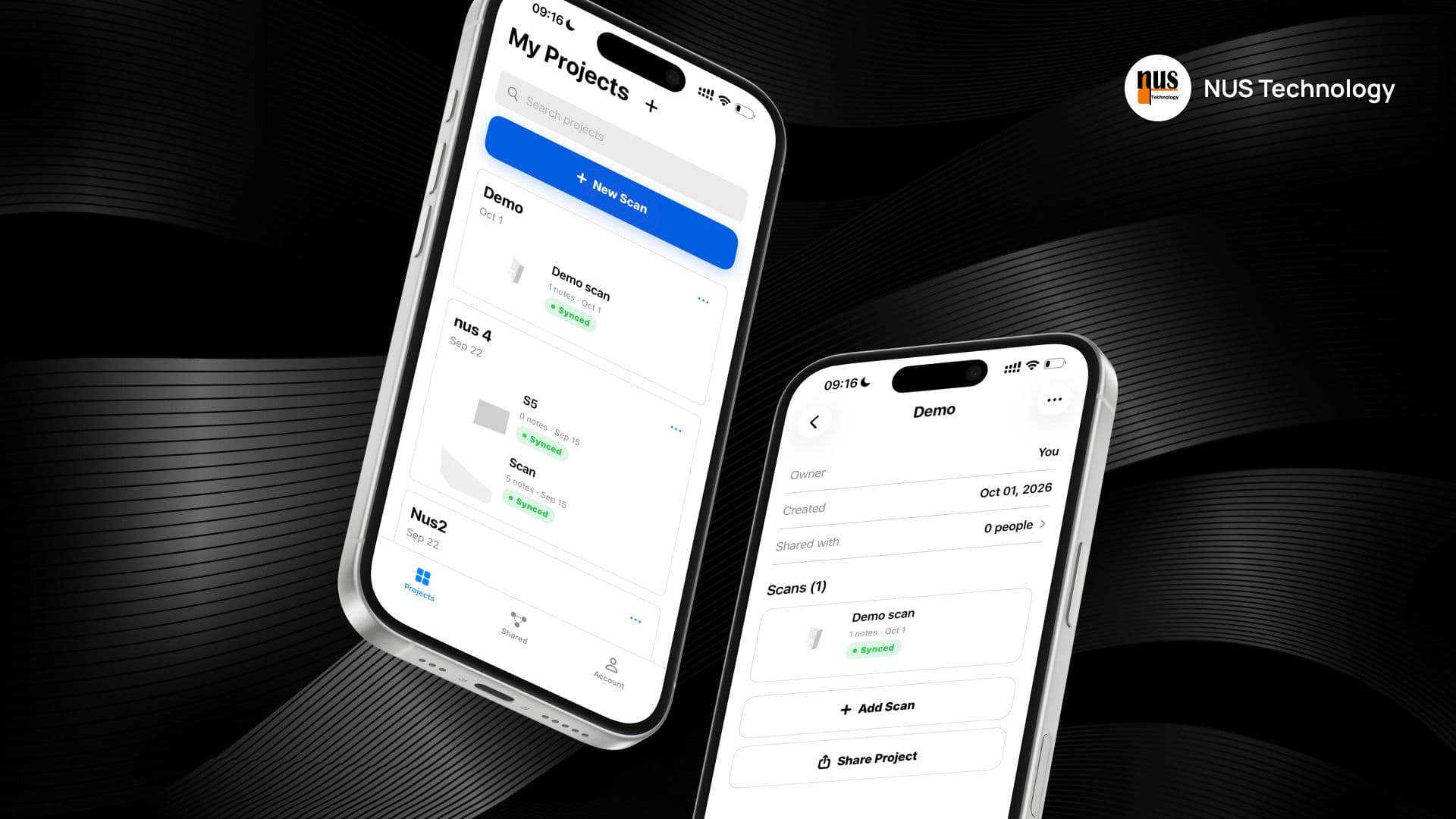
RoomScan is a native iOS application that transforms physical rooms into interactive 3D environments using Apple's LiDAR-based spatial computing technologies. Users can scan indoor spaces, explore reconstructed room models, attach notes to specific 3D locations, and share their projects with others.

Built for iPhone and iPad, the application combines RoomPlan, ARKit, RealityKit, and a dedicated backend to manage the workflow from spatial capture to synchronized collaboration.

The showcase demonstrates NUS Technology's capabilities in native spatial computing, interactive 3D development, offline-first synchronization, and permission-controlled data sharing.
ClearHear: Real-Time Offline Live Captioning
Mobile

ClearHear: Real-Time Offline Live Captioning

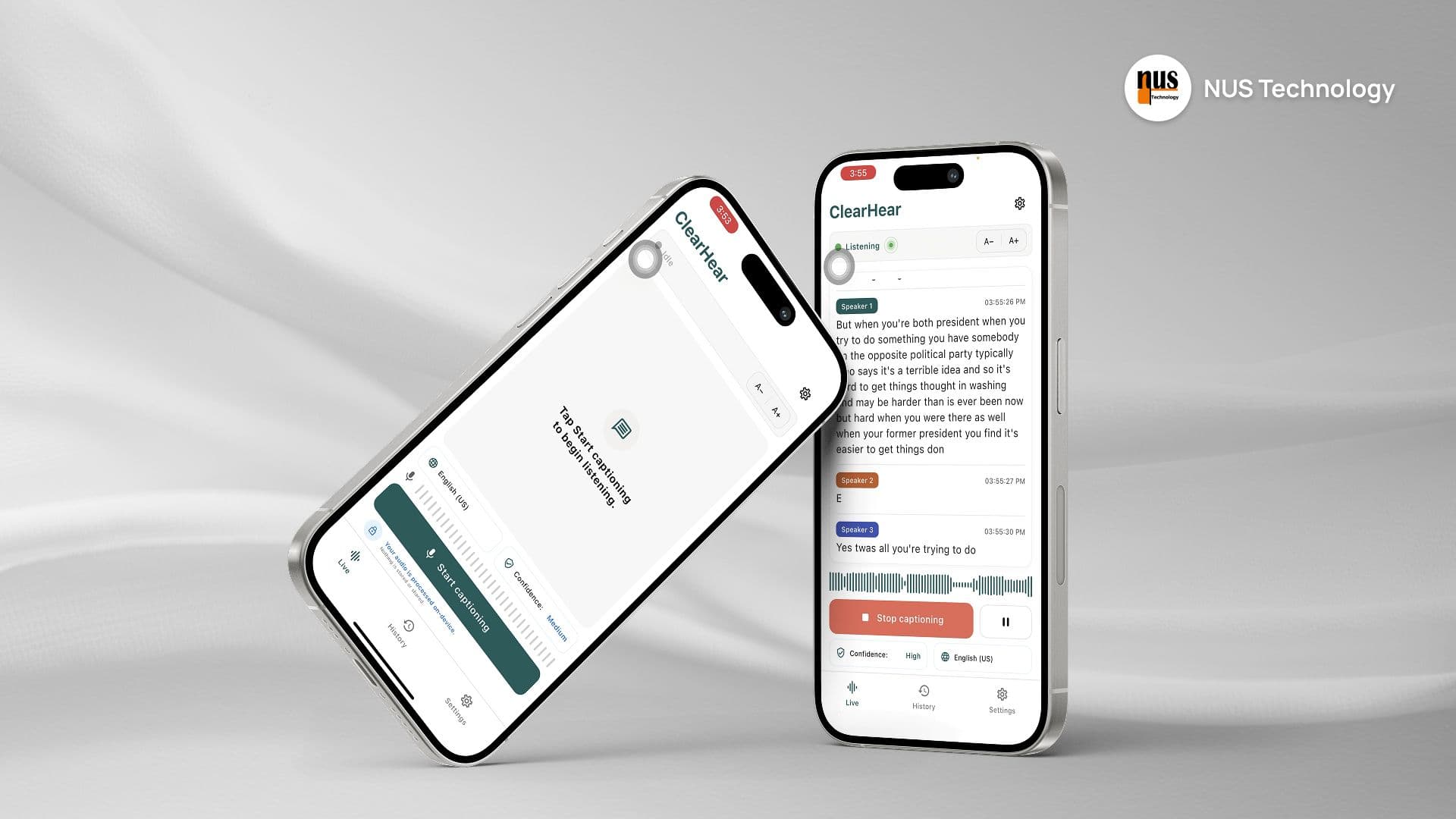
ClearHear is a cross-platform mobile application built to showcase NUS Technology's expertise in on-device AI, real-time speech recognition, and responsive mobile application development.

The app captures microphone audio and generates live captions entirely on the device, without requiring an internet connection. As users speak, captions appear immediately, update continuously with partial recognition results, and finalize in real time. Sessions are stored locally, can be searched and exported, and are automatically summarized using an on-device language model.

The primary engineering goal was simple: deliver offline captions that keep pace with live speech while maintaining a polished, production-quality mobile experience.

Zuzu: Real-Time Mobile Livestreaming
Mobile

Zuzu: Real-Time Mobile Livestreaming

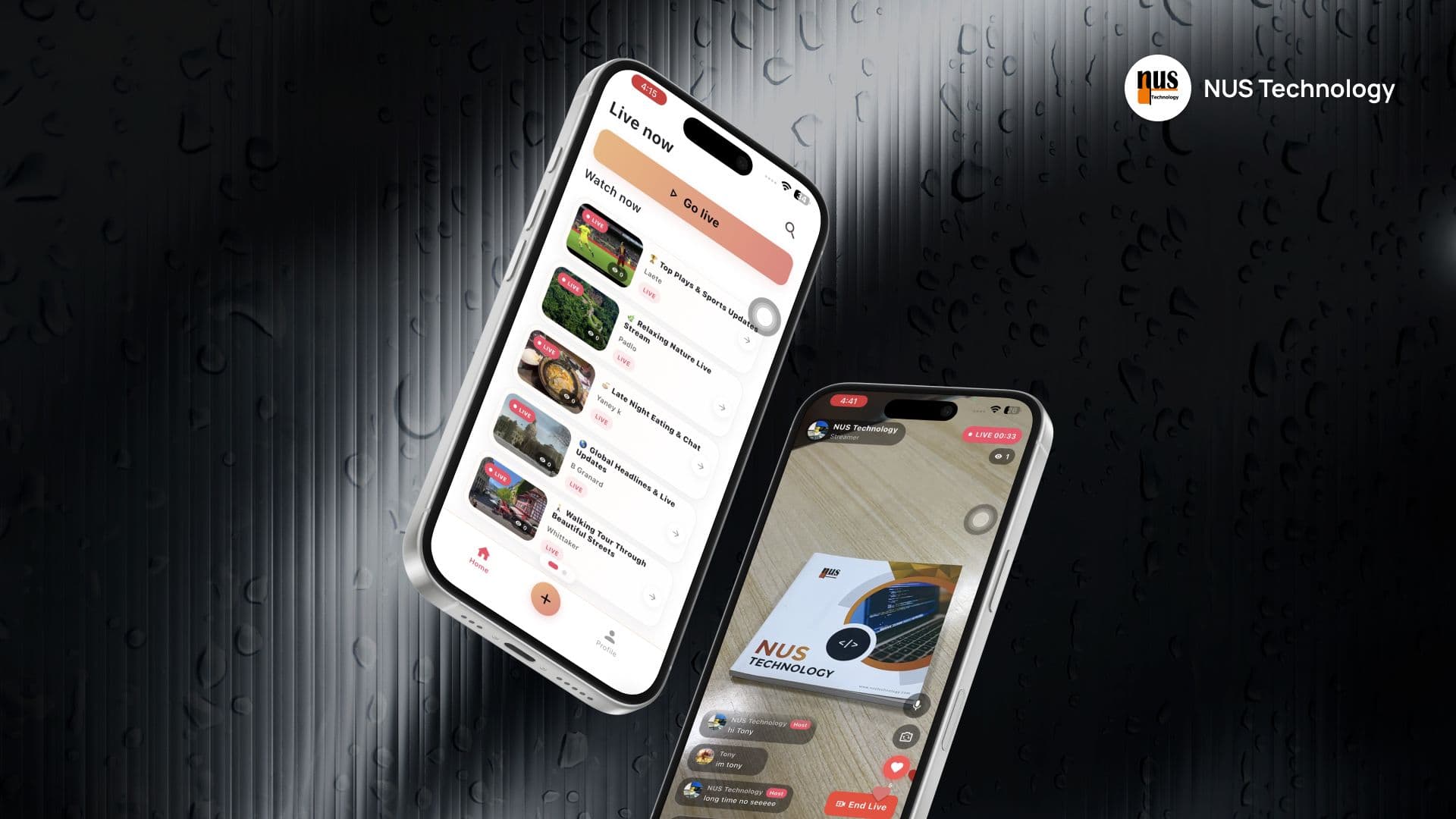
Zuzu is a cross-platform livestreaming app built to showcase NUS Technology’s expertise in real-time mobile development, WebRTC video streaming, and resilient session management.

Users can start a livestream directly from their phone or discover and watch active streams from other users. While watching, they can chat, send heart reactions, and see viewer activity update in real time.

Need a Similar Solution?

Let’s discuss your operational challenges and build a solution that fits your business.

CodeMonitorGrid with light