What We Learned After Automating the Entire Guest Journey
 June 10, 20265 min read
Hospitality automation sounds deceptively simple at first. Sync bookings, automate guest messaging, assign cleaners automatically, and generate smart-lock access codes. On paper, it looks like a straightforward software problem.
In reality, automating the entire guest journey is mostly an operational coordination challenge.
When we worked with Unito to build the Zens ecosystem, the goal was to automate the full short-term rental lifecycle, including booking aggregation, guest communication, cleaning coordination, facial-recognition check-in, and smart-lock access management. What started as a hospitality platform eventually evolved into a much larger operational ecosystem connecting multiple workflows and systems together.
You can also explore the full Zens hospitality automation case study to see how the platform evolved from an integration challenge into a complete operations platform.
The Guest Journey Is Really a Chain of Operational Workflows
One of the biggest lessons from the project was realizing how interconnected hospitality operations actually are.
A booking is not just a reservation record sitting in a database. It triggers an entire operational chain:
- guest onboarding
- messaging workflows
- cleaning schedules
- access management
- identity verification
- support coordination
Every workflow depends on another workflow completing correctly and on time.
For example, if a booking sync fails, cleaners may never receive assignments. If cleaning schedules are delayed, check-in timing becomes a problem. If access-code generation fails, guests can end up locked outside their property.
The technical challenge was not building these systems individually. The real challenge was keeping them synchronized reliably under real-world operational conditions.
Before Zens, many of these workflows were handled manually by property managers. Staff were constantly switching between spreadsheets, booking platforms, messaging tools, and cleaning schedules. As the number of properties increased, operational overhead scaled almost linearly with the business.
This is a common pattern we see across many industries. Businesses often start with disconnected tools and manual processes until operational complexity eventually becomes unmanageable. That is why at NUS Technology, we increasingly focus on building operations backbone platforms that unify workflows instead of adding more fragmented tools.
Automation Is Mostly About Handling Edge Cases
One misconception about automation projects is that success comes from automating happy-path workflows.
In reality, most engineering effort goes into handling exceptions safely.
The Zens ecosystem integrated multiple systems including Airbnb, Beds24, RemoteLock, and AWS Rekognition. Each integration introduced operational edge cases that had to be considered carefully.
Generating smart-lock access codes is a good example. At first glance, it sounds simple:
- guest books property
- system generates access code
- guest checks in
But operational reality quickly complicates the workflow:
- cleaners may still be inside the property
- guests may arrive early
- bookings may be modified last minute
- checkout times may change
- identity verification may fail
Now the platform requires additional logic:
- should access be delayed?
- should cleaners receive updated schedules?
- should support staff be alerted?
- should fallback access instructions be generated?
The difficult part was not creating automation itself. It was ensuring the automation behaved safely when real-world conditions changed unexpectedly.
This is also why operational platforms are fundamentally different from many consumer applications. A minor software issue in social media software may frustrate users temporarily. A synchronization failure in hospitality operations can disrupt an entire guest stay.
Reliability Matters More Than Feature Count
Another major lesson was that reliability matters far more than feature quantity in operational software.
Hospitality technology often markets futuristic capabilities like:
- facial-recognition check-in
- AI-powered automation
- smart-lock systems
- dynamic workflows
But guests rarely care how technically sophisticated the platform is behind the scenes.
They care whether:
- check-in works smoothly
- the property is clean
- instructions arrive on time
- support responds quickly
Operational consistency creates trust much more effectively than flashy functionality.
As a result, a significant amount of engineering effort went into:
- synchronization stability
- workflow monitoring
- retry mechanisms
- operational transparency
- failure recovery systems
The goal was not simply automation. The goal was dependable automation.
This mindset heavily influenced the platform architecture. We designed the system assuming external dependencies would eventually fail, APIs would change, and workflows would occasionally break. Building resilient fallback mechanisms became just as important as delivering features.
That architectural approach also allowed the system to adapt later when Airbnb eventually released official APIs. Because the platform already isolated external integrations behind abstraction layers, migrating away from custom solutions became far easier than it otherwise would have been.
Fragmented Systems Become the Bottleneck
One pattern we repeatedly observed during the project was how quickly fragmented operational tools become a scaling problem.
Many hospitality businesses initially operate using separate systems for:
- bookings
- guest communication
- locks
- cleaning coordination
- payment tracking
- support management
This works while operations remain relatively small.
But as complexity grows, disconnected systems create:
- duplicated data
- inconsistent workflows
- delayed synchronization
- operational blind spots
- manual coordination overhead
Staff end up spending more time managing systems than managing operations.
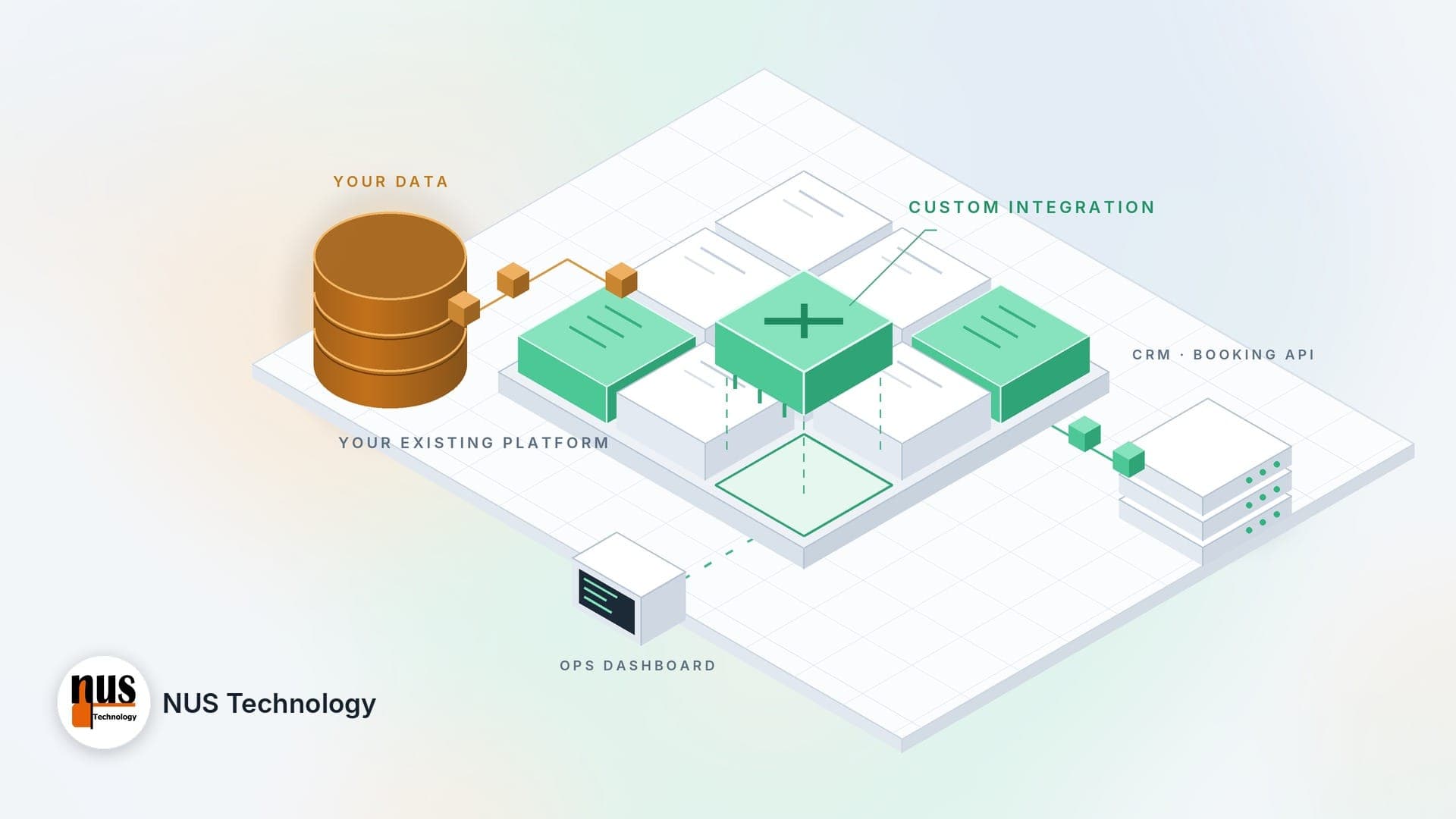
The Zens ecosystem solved this by acting as a centralized operational hub that connected all major workflows together. Booking updates automatically triggered downstream actions across communication systems, cleaning schedules, access management, and check-in workflows.
This reduced manual coordination significantly while also improving operational visibility across the business.
At NUS Technology, projects like this reinforced why workflow automation and operational visibility are often more valuable long term than simply adding isolated features to existing systems.
The Hardest Problems Were Operational, Not Technical
Interestingly, many of the hardest decisions during the project were not purely technical.
They were operational modeling problems.
For example:
- when should cleaners be assigned automatically?
- how should failed check-ins escalate?
- which workflows require human approval?
- what happens during overlapping bookings?
- how should late check-outs affect downstream operations?
Answering these questions required understanding how hospitality operations functioned in practice, not just how the software should behave technically.
This is one reason operational software projects often fail when engineering teams work without close operational collaboration. Building reliable systems requires understanding the business workflows deeply enough to model them accurately.
That experience reinforced the importance of strong discovery and operational analysis before development begins. At NUS Technology, this is why projects involving operational complexity often include dedicated business analysis and strategy consulting early in the process.
The operational model usually determines the technical architecture far more than people expect.
Good Automation Should Make Operations Feel Calmer
Perhaps the biggest lesson from automating the guest journey was this:
The best operational software becomes almost invisible.
When automation works properly:
- guests experience smoother stays
- property managers spend less time coordinating tasks
- cleaners receive clearer instructions
- support teams handle fewer emergencies
Operations become calmer and more predictable.
The success of the Zens ecosystem was not measured by how advanced the technology looked. It was measured by reduced operational friction:
- fewer manual tasks
- fewer synchronization failures
- fewer booking conflicts
- more reliable turnovers
- smoother guest experiences
You can see the complete operational workflow architecture and hospitality automation approach in the full Zens platform case study.
Ultimately, good automation is not about replacing people. It is about reducing unnecessary operational chaos so teams can focus on higher-value work.
Conclusion
Automating the entire guest journey taught us that operational software is fundamentally about coordination, reliability, and workflow design rather than flashy features alone.
The real challenge was never just integrating booking platforms or generating smart-lock codes. It was building a system capable of coordinating dozens of interconnected operational workflows under unpredictable real-world conditions.
That experience continues shaping how we approach complex operational systems today at NUS Technology. If you want to see how those principles were applied in practice, you can explore the complete Zens case study here.