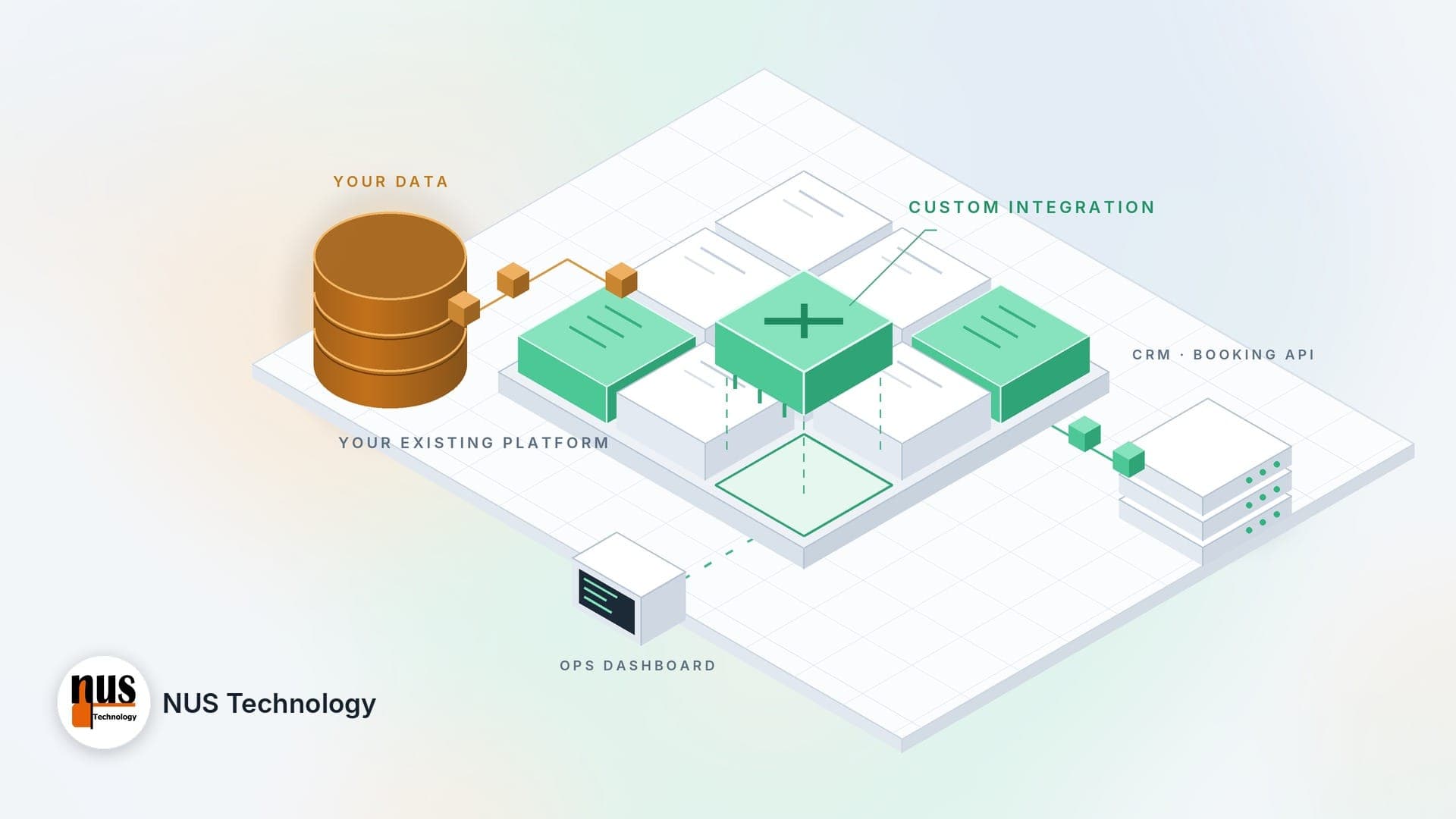
When to Build Custom Software vs Use Off-the-Shelf Tools
 May 27, 20267 min read
Most companies don't start by building custom software. They start with the fastest, cheapest option available: a SaaS subscription, a spreadsheet, maybe a combination of both. That's not a bad decision. It's often the right one.
But at some point, the tooling that helped you move fast starts slowing you down. Workflows get duct-taped together. Data lives in three places at once. Your team works around the software instead of with it. When that happens, the question shifts from "what tool should we use?" to "should we build something ourselves?"
This post gives you a clear-eyed answer. Not a theoretical comparison of pros and cons, but the actual operational signals that tell you which side of that decision you're on.
Why Off-the-Shelf Tools Are the Right Starting Point
Before you can know when to build, you need to appreciate why buying makes sense in the first place.
Off-the-shelf software, whether it's a CRM, project management tool, or a vertical SaaS platform, is built for common needs. It's fast to set up, maintained by someone else, and comes with an existing user base and support community. For non-core operations like payroll, email marketing, or internal HR, a proven SaaS product will almost always beat something custom-built.
The economics make sense early on too. A $50/month subscription with zero development time is a better bet than a six-month build when you're still validating your business model or trying to move fast. SaaS tools are also how you discover what you actually need before committing to building it.
The problem isn't that off-the-shelf tools are bad. It's that they're designed for the average company's workflow. Once your operations develop real complexity, that average stops fitting.
The Signals That Tell You Off-the-Shelf Has Run Its Course
Here's what most articles on this topic miss: the decision isn't about features. It's about operational drag. These are the concrete signs that your current tooling has become a liability:
Your team has built a second layer of software on top of your software. If people are copying data from one tool into another, running manual reconciliation scripts, or maintaining a spreadsheet that "fills the gaps", you're already maintaining a system. You're just not owning it.
Integrations are fragile or impossible. Zapier and native integrations cover a lot of ground. But when you need real-time sync between legacy systems, compliance-grade audit trails, or deeply customised data flows, you hit a wall fast. Fragile integrations are a maintenance burden and a source of errors your business can't afford.
You're paying for the tool's complexity, not yours. SaaS prices rose 12.2% in 2024 while general inflation ran at 2.7%, a gap that's particularly painful when you're only using 40% of the product's features. Every renewal, you're paying for capabilities built for someone else.
You're changing your process to fit the software. This is the biggest one. Custom software adapts to how your business actually works. When you find yourself consistently modifying your operations to work around software constraints, you've inverted the relationship.
The Real Cost of Fragmented Tools (and Why It Compounds)
The financial case for building is often misunderstood. Companies focus on the upfront cost of custom development and compare it to a monthly subscription price. That comparison is almost always misleading.
Research from an independent consulting firm cited by Shopify shows that businesses with fragmented tech stacks face up to 36% higher total cost of ownership compared to unified platforms, much of it hidden in integration overhead and operational complexity.
According to Zylo's 2025 SaaS Management Index, the average company now spends $49M annually on SaaS, with spending increasing 9.3% year over year in 2024, even as the average software portfolio grew by only 2.2%. That gap between spending growth and portfolio growth is what SaaS sprawl looks like in numbers.
The hidden costs accumulate in predictable ways: staff time spent on manual data entry between disconnected systems, engineering effort maintaining brittle integrations, onboarding friction from a patchwork of tools, and the compounding cost of decisions made without reliable unified data.
When you model the full cost of ownership over three to five years, the economics of custom software often look very different from the initial comparison. The monthly subscription seems cheap. The total system cost frequently isn't.
When Custom Software Development Is the Right Call
Custom software earns its place in specific, recognisable situations. Here's where it consistently wins:
Your operations are your competitive advantage. If the way you deliver your service is what differentiates you from competitors, generic tools force you to converge toward the industry average. A purpose-built operations backbone platform lets you encode your specific process, not a best-practice approximation of it.
You need deep system integration. When success depends on reliable, real-time synchronisation between multiple systems, including legacy platforms or compliance-grade workflows, off-the-shelf tools typically can't deliver. Complex system integration at this level requires owning the integration layer, not renting it.
You're scaling a multi-sided or multi-tenant operation. Platforms that serve multiple clients, locations, or user types with isolated data and customisable workflows quickly outgrow horizontal SaaS products. The configuration complexity of bending a generic tool to a multi-tenant use case often exceeds the cost of building properly.
You've already outgrown two or three off-the-shelf alternatives. This is a strong signal. If you've migrated from one SaaS product to another and still have the same friction, the problem isn't the tool. It's the tool category. Custom software is the right answer when no existing product can meet your requirement without significant workarounds.
A Framework for Making the Decision
There's no universal answer, but there is a useful decision framework. Think about the software in terms of three tiers:
Tier 1: Commodity functions. HR software, accounting, email, basic project management. Use proven off-the-shelf tools. There's no competitive advantage in building these, and the maintenance cost isn't worth it.
Tier 2: Operational workflows that differentiate you. Booking management, field service dispatch, multi-party contract handling, inventory management with custom pricing logic. This is where the build vs buy decision becomes meaningful. If an off-the-shelf tool can handle it at 85% fidelity, the 15% gap may be tolerable early on. Once that gap creates daily operational friction, you build.
Tier 3: Core platforms that run the business. If software is the product, or the operational backbone everything else depends on, it should almost always be custom. This is where workflow automation and operational visibility genuinely can't be delegated to a generic vendor.
When NUS Technology worked with Propmap.io, the client needed a multi-tenant field service management platform connecting office managers with field workers, including GPS tracking, dynamic scheduling, and offline mobile sync. No off-the-shelf product could handle the combination of per-organisation data isolation, customisable workflows, and offline-first mobile requirements. Building from scratch with Ruby on Rails for the web platform and Flutter for the mobile app resulted in a 40% reduction in dispatcher administrative time and 25% better field productivity. That kind of outcome isn't available inside a generic field service SaaS.
Similarly, when the team at HelpfulCrowd was struggling with a Rails platform hitting 100% CPU utilisation and spiralling AWS costs, the answer wasn't to migrate to a different SaaS product. The codebase held valuable business logic that couldn't be replicated elsewhere. The right move was a deep technical audit and platform modernisation, which halved infrastructure costs and doubled their feature release speed.
What to Do Before You Build
Before committing to custom development, run through this checklist:
Document what your current tools actually can't do, not what you wish they could do. Be specific. "Our Shopify setup can't handle the multi-vendor pricing logic we need at order creation" is actionable. "We want something better" isn't.
Map the true total cost of your current setup. Include staff time for manual workarounds, integration maintenance, duplicate data entry, and the productivity cost of context-switching between five different tools.
Identify whether the gap is a configuration problem or a capability problem. Sometimes a better-configured off-the-shelf tool genuinely does the job. A good business analysis and strategy process before a build can save you from over-engineering a solution.
Get clear on your timeline. Custom software takes months, not days. If you need something operational in six weeks, the answer is almost always to start with an existing tool and build later. If you're planning six to twelve months ahead, build is often the right call.
FAQ
How much does custom software development typically cost compared to SaaS?
The upfront cost of custom software is higher, often starting at tens of thousands of dollars for a focused platform and scaling based on complexity. But the comparison should be total cost of ownership over three to five years, not monthly subscription vs development invoice. SaaS at scale carries subscription inflation, per-seat pricing, integration costs, and the cost of operational workarounds. Many clients find that custom software becomes the more economical option after 18 to 24 months of serious use.
Can you start with off-the-shelf and migrate to custom later?
Yes, and this is often the smartest path. Off-the-shelf tools help you discover what you actually need before you invest in building it. The risk is in waiting too long. Migrating from deeply embedded SaaS tools once the business is dependent on them is harder than building early on a stable foundation. The best time to plan the migration is before the technical debt from workarounds becomes unmanageable.
What types of businesses benefit most from custom software?
Businesses with operationally complex workflows that generate genuine competitive advantage, field service and logistics companies, multi-sided marketplaces, healthcare and compliance-heavy industries, and any operation where the software needs to serve multiple distinct user types with isolated data. Also any company that has found itself on its second or third off-the-shelf migration in the same category without resolving the underlying problem.
How do I know if my current SaaS tools are actually limiting growth?
The clearest signals are your team's workarounds. Count how many manual steps exist between your tools. Track how long onboarding a new operational workflow takes. Look at how many people are involved in tasks that should be automated. If your ops team is spending more than a few hours per week moving data between systems or running reconciliation checks, the tools are limiting you.
Conclusion
The build vs buy decision isn't a one-time choice. It's a moving threshold that shifts as your business grows in complexity. Start with off-the-shelf tools when you're validating, moving fast, or running commodity functions. Build when your operations have developed real differentiation that no generic product can serve, when integration requirements exceed what SaaS can reliably handle, or when the cumulative cost of fragmentation exceeds the cost of owning your own platform.
If you're at that inflection point and want a clear-eyed view of your options, the team at NUS Technology has been through this decision with clients across healthcare, eCommerce, logistics, and field services. Talk to us about your setup and we'll give you an honest read on whether building makes sense for your situation.